
A successful business ownership transition is a sign of a healthy, viable, sought after, and growing operation. So how long does the process take and how do you prepare?
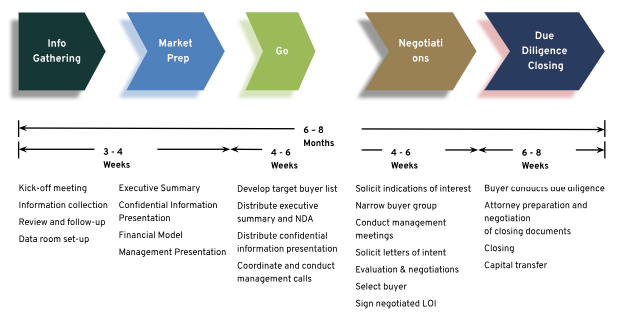
Every sale is different. Timeline depends on a myriad of variables that include deal structure complexity, due diligence information flow, financing contingencies, and legal negotiations. A good M&A team can give realistic estimates and help you anticipate potential delays; but a trusted intermediary can walk you through an outline of the expected timeline, help you to identify where there may be potential impasses or delays; and most importantly, walk through the process alongside you and make sure that you get to close in a timely, efficient, and orderly manner. You should expect that your M&A team will facilitate all aspects of the sale process from initial conversation through to closing and throughout the transition.We have over 50 years of combined transactional experience and have learned how to identify potential impasses. We know what to expect throughout a transaction and can help you stay several steps ahead of the transaction timeline.
The Typical Business Sale Timeline
Phase 1 — Pre-Market Preparation
Initially, SMP Capital Partners team will provide a complementary valuation that will outline your current range of value based on careful analysis of your company’s historical and year-to-date financial data, current and thoroughly researched comparable industry sales, and commonly held industry standard metrics that influence business value, specifically infrastructure and org chart strength, customer concentration, owner role, and growth potential.
First impressions count. Buyers want to see clean, well-organized financials including accurate profit and loss statements, tax returns, and balance sheets. If there are inconsistencies or gaps, remedy them early on. Giving buyers a clear and accurate financial picture encourages confidence and helps to set the stage for an efficient transaction. In addition, a well-prepared business signals stability, manageable risk, and identifiable growth potential.
Phase 2.1 – Marketing
The marketing process generally takes 2-3 weeks as the SMP Capital Partners develops customized marketing materials specifically designed to highlight your company strengths and identifiable growth opportunities. We spend significant time dedicated to deep learning about your industry and how your business fits into the ecosystem. We will be the resident industry experts before we go to market. In addition, many times buyers use our marketing material which includes industry data, geographical information, and local demographics as a baseline document as they build out their business plans for their limited partners and senior debt lenders. Our marketing is built to generate motivated and serious buyer activity and it works.
Phase 2.2 — Buyer Engagement
Buyer engagement can take 1 to 3 months as the SMP Capital team applies a mix of confidential online platforms, targeted outreach, curated buyer databases, and strong industry relationships to generate buyer activity. Rest assured that when we are prepared to make a buyer introduction, you will interview vetted buyer prospects who have agreed to follow a focused and collaborative transactional process.
You can be confident that when we introduce you to a buyer, they have completed the following steps every single time:
- They will have signed our non-disclosure agreement that has depth and weight
- They have met with our team and have walked us through their investment criteria, discussed their acquisition portfolio, and their lending/limited partner relationships.
- They have agreed to participate in our transactional process which is streamlined for efficiency and precision.
In addition, we manage all transactions in efficient and secure data rooms and regularly monitor access authority and document review. We redact sensitive information and market your business in a manner that protects your proprietary processes and information, tells your story, and protects your identity from strategics and competitors alike so you stay in control of the process.
Phase 3 — Negotiation and LOI
Transactions are living, breathing organisms. They change, shift directions, and drag on if you are unorganized and unsure of next steps. Once we sign an exclusivity agreement with a buyer group, we will work collectively to establish a comprehensive transaction timeline and closing checklist to manage the transactional process.
Picking the right buyer can be difficult, especially if you have multiple suitors in play at the same time. It can be challenging to know if you are comparing apples to apples, or apples to a football bat. The seasoned SMP Capital Partners team will help you assess your offer structure, context, and overall benefit to you and your team. The highest purchase price offer may not always be the best bet in the context of a sellers’ total takeaway, and there are a number of variables to consider including total purchase price, working capital, balance sheet items, and ancillary benefits, etc.
Phase 4 — Due Diligence
History as an academic study is vitally important because you can determine how to meet the moment w/lessons from the past. Organized financial documentation provides a clear and accurate map of historical performance while allowing the organization to establish definable and achievable future projections. A complete set of accurate books and records is the best instrument to guarantee a streamlined and efficient diligence process. In addition, clearly outlined liabilities and deliberate solution based problem solving limit a business’ exposure and minimizes surprises, headaches, and timeline delays.
Phase 5 — Purchase Agreement and Closing
Once you close the books on the financial review and you are satisfied w/books and records, it is time to document the transaction with a purchase agreement and supporting schedules that tell the business story. In conjunction with legal documentation you will coordinate transition w/the seller and learn about the org chart, negotiate transition responsibilities, training schedule, consulting terms, and get a feel for how the day-to-day operation works.
Transitioning out of business ownership is really hard. We would be lying to you if we said otherwise. If managed well, by professional intermediaries like the SMP Capital team, the pre-close transition process will help minimize the stressors and streamline the process from start to finish.
What Slows a Deal Down
Sellers have to be emotionally ready to transact because transactions are hard to complete and they are final. Sellers always have an emotional experience when transitioning. Nearly every seller experiences “deal fatigue” even when they work w/folks like us. It is a lot of change. We help manage the emotional ebbs and flows of deal making and have the tough conversations so that buyer and seller can start transitioning post closing on good terms.
A few thoughts to remember that can slow the deal process and limit the probability of a successful close: Stop running personal expenses through the business or set up ONE credit card for those transactions. Get all sales on the books. Set-up a clean month end closing process and review the statements every month with the respective team. Look to set-up good KPIs to help drive the business and get buy in from the org chart on targets.
In addition, key obstacles and impasses that slow the transaction process:
- Dated and/or inaccurate financial records
- Unresolved legal issues (pending litigation, contract disputes, compliance gaps)
- Inconsistent or unstable customer concentration
- Owner who is too involved in daily operations with no management layer
- Misalignment between seller expectations and market reality on price
- Emotional decision making or second guessing mid-process
- Third party delays (landlord consent, license transfers, lender approvals)
- Trying to run a full sale process without experienced advisory support
What Speeds a Deal Up
Good transactions are built on trust, integrity, respect, and good faith commitment. Experienced M&A teams like SMP Capital Partners manage the transactional process, timeline, and buyer communication efficiently and effectively. In addition, sellers must prioritize the transaction, respond timely to information requests, and build a strong trusting relationship w/the buyer through transition.
M&A deals are not easy to transact at any dollar amount. Along with a realistic range of valuation based on current market conditions and comparable transactions, several other business characteristics help keep transactions on the fast track to close.
Accurate and Current Reporting
- Clean, timely closed books and records along with current financial statements that tie to tax returns
- Accurate Org Chart with clear reporting hierarchy (Management Team and Staff)
- Clear leadership structure and owner objectives (sellout, recap, etc.)
- Current equipment and asset lists with values and replacement costs
- Accurate and defendable financial statements
- Structured back office processes – easy access to important information
Business Model and Growth Potential
- Strong branding, customer loyalty, and customer diversity create a unique value proposition
- Scalability and Growth Opportunities: buyers pay for what you have built but buy for what they can grow
- Diversified customer base with no single customer exceeding 15 to 20 percent of revenue
Market Position
- Brand reputation and market share – How does your business present to the outside world?
- Industry trends and competitive landscape – How did you get here and where do you see the industry going? How have you planned for or adapted to change and how are you planning for that today?
Company Culture
- Defined company mission and core values – How do your strategic objectives align with your vision and values?
- Employee retention and satisfaction – They are the cornerstone of every strong business and buyers find value in stable org charts.
Why Rushing the Process Hurts Sellers
It is difficult to maximize the value of an M&A transaction when there is a forced sale due to an array of issues that include burnout, ill health, familial emergencies, intense competition, lack of available working capital, changing industry trends, key customer loss, economic volatility, etc.
Business owners rarely play out the entirety of a business exit prior to making the decision to put their business on the market; so we tell them to call us when they do not have time to call us because that is when they have options. It is never too early to start planning for an eventual exit. There are variables, moving parts, and a lot of unknowns that require thoughtful consideration and mindful awareness, in some cases, years prior to a potential sale.
We help navigate the emotional fluctuations of pre-planning while managing a transparent process. It takes foresight and experience to build out a transactional plan. We have worked with businesses at every life cycle stage and understand that although each business’ needs are unique and specific, there are certain standards that are universal. We will make sure those foundational standards are solidified while we help plan for your eventual exit.
Next Steps
At SMP Capital Partners, we manage the entire process — pre-market prep, marketing, buyer engagement, negotiations, due diligence, and legal documentation through to closing. From start to finish, we work to create an efficient and well managed transactional process for you and your shareholders. We understand the mechanics and nuance of deal making at SMP Capital Partners and it sets our team apart in the marketplace.
Think of the SMP Capital team as a strategic partner — not just someone to “list” your business. We combine deep industry knowledge, strong buyer networks, and a strategic, data-driven approach that deliver maximum value. We will help you traverse the sales journey, navigate through unexpected challenges, and provide you with confidence that you are not in this process alone. It is never too early to start the conversation. Call us today and let us see how we can help.